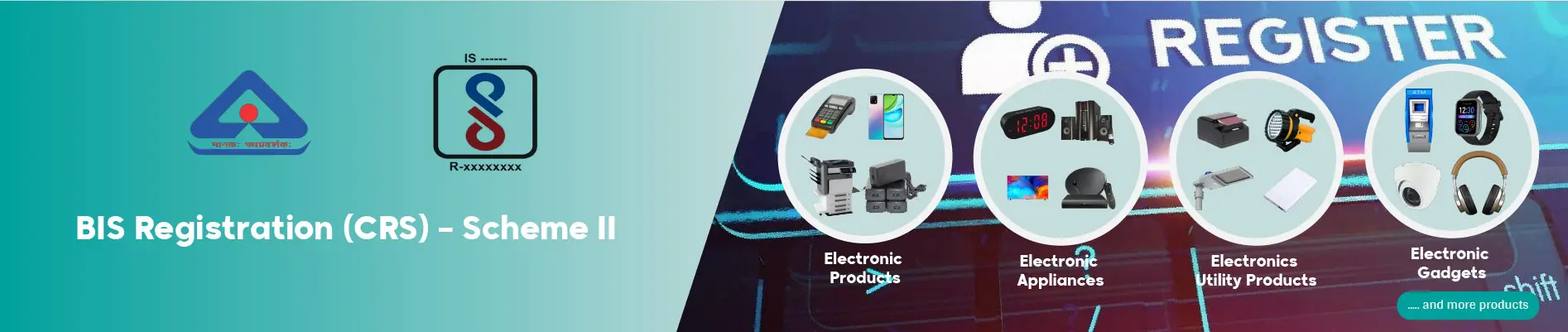
BIS (CRS) Registration – Scheme II
The Ministry of Electronics and Information Technology introduced the Compulsory Registration Schemes (Under Scheme-II) for electronic and IT products. The scheme presently covers 76 products. Every manufacturer and importer of electronic products is required to obtain a BIS Registration. This helps to protect the Indian Consumers from low-grade and defective products. The BIS CRS scheme ensures that only quality-assured and safe products are available in the Indian market.
After obtaining the BIS license, manufacturers must display the Standard Mark (CRS Mark) along with a unique registration number. The BIS CRS Licensing is compulsory for both Indian and Foreign Manufacturers. No good can be imported, manufactured, stored, distributed, or sold in India unless they have the CRS Mark.
Eligibility Criteria for Applying for BIS CRS Registration
Below, you can go through the essential criteria under the CRS Scheme II:
- Manufacturer Identification: The applicant has to be a manufacturer. The application will not be considered for a trader or retailer.
- Manufacturing Location: Separate registrations will be required for each manufacturing unit, although the product itself will be identical.
- Product Coverage: The product should fall in any of the notified categories of the BIS CRS.
- Standard: The product shall comply with the applicable IS prescribed by BIS.
- Importing foreign products: Manufacturers outside India need to make an AIR in India. An application will be made by an authorized person.
- Testing: Samples tested by a lab recognized by BIS are required, and the report provided must confirm compliance.
- Labelling Requirement: Marking after the certificate of registration is obtained from BIS.
- Product Categories: Only such products that fall in the mandatory categories of CRS quality for certification.
Mandatory Product List for BIS (CRS) Registration – Scheme II
Below is a list of products that require mandatory compliance in India:
Procedure for BIS CRS Registration
Step of the BIS Registration under the Compulsory Registration Scheme requires the following to be covered for both foreign and domestic manufacturers.
1. Process for the Foreign Manufacturer
Refer to the following steps for CRS BIS Registration:
- Nominate an Indian representative for the foreign manufacturer.
- Apply online.
- Get a sample tested at a BIS-approved laboratory. Apply with the sample test report online.
- BIS officials will verify your application.
- Take your license.
2. Process for the Domestic Manufacturer
Below are the steps for Indian manufacturers:
- Apply online
- Along with the sample testing report from a BIS-approved laboratory.
- Before issuing a license, BIS officials shall verify the application.
- If there is no query, then BIS will grant the license
Documents Required for BIS Registration in India
To register with the Bureau of Indian Standards (BIS), you need to provide various documents, including proof of business registration, factory details, product information, and testing documents.
- Business License (Manufacturing Unit Address Proof with scope of business in original and English translation)
- Component details (CCL Format)
- Trademark Certificate
- Documents of Authorized Indian Representative (AIR)
- Authorised Signatory details of Manufacturing Unit (Name, Designation, Contact number, Email ID)
Timeline to Obtain a BIS Licence
To know the timeline for CRS BIS Registration, go through the pointers given below:
- If all documents and reports are in order, the BIS CRS License will be granted within 20 working days.
- If the documentation or conformity is unsatisfactory and not correct within 30 days, then the rejection will be given with notice by a BIS Officer.
- If you have already tested your product and you want to submit the earlier test reports for BIS CRS Certification, the test report must be older than 90 days from the date of receipt of the online application in BIS.
- If the documents submitted are in order, then BIS will process the registration. Independent samples are collected only in the event of surveillance.
Validity & Renewal Of BIS License
A BIS license for electronics products is issued for a minimum of two years. Based on observations and if no adverse comment has been received, the CRS Certificate shall be considered for renewal in a minimum of 2 years. This license for electronics products shall be issued for a minimum period of two years, and in case there has been no adverse feedback regarding the license in routine observation, the BIS certificate/license shall be considered for renewal for a minimum period of two years upon the licensee's request.
If the renewal application and BIS CRS Registration Fees are not received from the licensee within 90 days of the validity period (2 years), the license shall stand terminated. Acceptance of the request for renewal of the Licence is also subject to the payment of the application fee, annual fee, processing charge, or any other due charge before such request for renewal of the BIS license.
BIS CRS Certification India Fee Structure
If you are looking for the fee details of a BIS Registration in India, please refer to the table below for a detailed breakdown of the BIS CRS Certificate cost. Let’s take a glance.
|
COST FOR BIS REGISTRATION / ELECTRONICS PRODUCTS (Government Costs) |
|||
|
Type of Fee |
New Application |
Renewal |
Inclusion |
|
Application Fee |
1000 |
1000 |
1000 |
|
Processing Fee* |
25,000x2 = 50,000 |
25,000x2 = 50,000 |
15,000x2= 30,000 |
|
Registration Fee* |
1000 x 2 = 2000 |
1000 x 2 = 2000 |
1000 x 2 = 2000 |
|
Total |
53,000 |
53,000 |
30,000 |
|
Note* 1. The processing fee and registration fee need to be paid within 2 years, as registration numbers will be granted initially for two years. 2. The cost of BIS registration will depend on the following factors: · Location and Name of the Manufacturing Process · Types of Products and model quantity · Testing fee for the products · Govt. Fee (BIS) and ERCS Service fee |
|||
Benefits of Obtaining a BIS Registration Certificate
The advantages of the Compulsory Registration Schemes are:
- Legal compliance: It helps in complying with the BIS regulations, avoiding penalties and product bans.
- Market access: make your product available to a large number of consumers
- Product credibility: a quality assurance mark that increases the trust of consumers.
- Competitive advantage: distinguishes products from uncertified competitors, thus increasing reputation.
- Consumer safety: Ensures the products are safe and reliable for the end-user.
- Export opportunities: Allows exports to countries with equivalent quality standards.
- Customs Clearance: Easy clearance at customs simplifies imports, thereby eliminating delays.
- Business growth: It gives partners confidence and creates new opportunities.
- Cost Efficiency: There is a risk of recalls, fines, and reputational damage.
- Environmental compliance: The product standards would be sustainable and energy-efficient.
What is BIS Registration for Import in India?
BIS Registration for Import is simply a compulsory certification required by the Bureau of Indian Standards (BIS) for certain products being imported into the country. Foreign manufacturers can obtain this certificate through the BIS Foreign Manufacturers' Certification Scheme. If a product is imported into India, approval is essential to sell or distribute that product in the Indian market. BIS-registered products can legally obtain import clearance for customs.
BIS Registration is a requirement for overseas manufacturers, traders, and importers. This is essential for all imported products if you wish to clear customs and then access the Indian market. CRS BIS applies to a wide range of products, including electronics, IT equipment, consumer appliances, steel items, and others, especially if those products are part of the BIS Compulsory Registration Scheme.
Why Choose ERCS Private Limited?
ERCS, as a BIS CRS Certificate Consultant, serves as a channel between you and the BIS officials. Our skilled team works hard to uphold the legitimacy of the entire process of getting a certificate for your company. We will support you from verifying the product's applicability and document preparation to awarding approval. Our goal is to make the entire procedure less complicated and hassle-free.
Frequently Asked Questions (FAQs)
Applications for BIS CRS registration are only accepted from manufacturers. It assists in guaranteeing that goods fulfil the necessary Indian requirements. Retailers, distributors, or traders can't apply for certification. To process the application, foreign firms must designate an Authorized Indian Representative (AIR).
To meet the necessary standards, manufacturers must test for them in labs approved by BIS. The BIS portal is used to apply online, along with test reports and other pertinent papers. After fees are paid, the application is reviewed by BIS, which then approves registration.
Yes, foreign manufacturers need to register with BIS CRS for the sale of products in India. They are required to appoint an authorized Indian representative who takes care of the application and compliance process. Thus, foreign-made products are assured to be by Indian standards and legal requirements.
Product samples must be sent by manufacturers to a laboratory approved by the BIS for comparison with applicable Indian Standards (IS). After testing the product, the lab provides a test report attesting to compliance. The BIS CRS registration application is submitted with this test report.
The registration process for BIS CRS typically takes four to six weeks. The accuracy of the application, test results, and prompt answers to BIS inquiries all affect the time. If more information or explanation is required, it could be postponed.
Indeed, a BIS CRS registration must be renewed before its two-year expiration date. To extend the accreditation, manufacturers must pay renewal costs and provide updated documentation. If standards or product specifications change, retesting can be necessary.
The BIS CRS (Compulsory Registration Scheme) under Scheme II requires safety certification for specific electronic and IT products, ensuring they comply with Indian safety standards before being sold or imported into India.
Scheme II, known as the BIS Compulsory Registration Scheme, applies to specific IT and electronic goods, primarily focusing on consumer products that are not considered critical. Unlike Scheme I (ISI Mark) and the Foreign Manufacturers Certification Scheme (FMCS), Scheme II does not require factory inspections or testing of samples by BIS officials.
A foreign manufacturer must appoint an Authorized Indian Representative (AIR) to apply on their behalf in India.
Selling or importing products not registered under the CRS is illegal and can lead to seizure, fines, and legal action under Indian law.
Manufacturers of notified electronic and IT products, such as printers, laptops, power banks, LED lights, and mobile phones, must obtain CRS Registration before selling in the Indian market, whether they are domestic or foreign.
Need Expert Advice?
Feel Free to Connect with Us
Prompt reply within hours
Continued support
To give you the best compliance services in India, experienced BIS certification consultants at ERCS are ready to assist you at every stage of certification. Find out everything you need to know about the compliance your product requires to get into the Indian market and develop a trusted customer base.