BIS Registration (CRS) for Wireless Microphone – IS 616 : 2010
Category: BIS Registration (CRS)
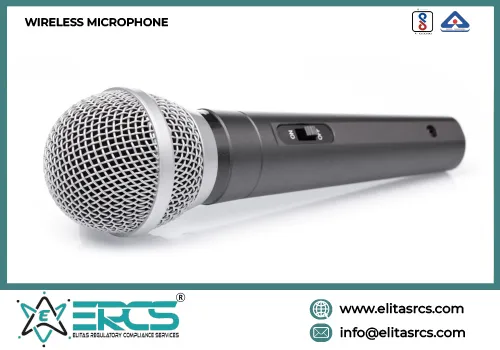
A wireless microphone transmits audio signals without the use of a physical cable, utilizing Radio Frequency (RF) or Bluetooth technology to connect a receiver linked to a sound system. This feature allows users great mobility and convenience. The BIS Registration of Wireless Microphones as per IS 616 is a mandatory compliance demand for manufacturers and importers to sell in the Indian market.
BIS grants this certification under the Compulsory Registration Scheme - II, which aims to ensure that electronic and audio equipment meets safety and quality marks. The Bureau of Indian Standards, on 1st April 2021, aligned the Indian standard 616 with international safety standards and aims to protect users from electrical hazards such as electric shock, excessive temperature rise, fire risks, and leakage failures. It sets out detailed requirements regarding the design, construction, material, insulation, and performance of wireless microphones and similar audio equipment.
Key Specifications of Wireless Microphone for BIS Registration
A wireless microphone comprises three parts- The Input Source, The Transmitter, and The Receiver. The transmitter receives an audio signal from the input source. The transmitter transforms the audio signal into a radio signal before sending it out into the surrounding area. It uses the VHF or UHF frequency band and allows the user's voice to be transmitted wirelessly. In short, a wireless microphone is used for sound recording without a physical cable that is connected to amplifying equipment. To provide reliability, standard quality, and consumer safety, the BIS registration of a wireless microphone is compulsory.
Key Highlights for IS 616 for Wireless Microphones
BIS Registration Requirements for Wireless Microphones per IS 616:
- Scope: Wireless microphones are defined as electronic audio devices that draw power from circuits (such as mains, batteries, or external power supplies).
- Technical Documentation: A technical specification sheet or user manual must be submitted, detailing the operating frequency (UHF/VHF/2.4GHz), power output, and battery information.
- Energy-Based Safety: To comply with IS 616, the wireless microphone must be designed in accordance with hazard-based safety engineering principles to minimise the risk of electric shock, fire, or injury when using the product.
- Preventing Electric Shock Hazard: The design of the wireless microphone must prevent access to live parts during normal operation.
- Insulation: The wireless microphone must have sufficient basic, supplementary, or reinforced insulation between hazardous voltages and any accessible parts.
- Elimination of Clearance & Distances: The wireless microphone must have enough clearance and creepage distances to minimise the risk of an electrical breakdown.
- Temperature Limits: The wireless microphone must operate within the specified temperature rise range for both normal and abnormal use conditions.
Benefits of BIS Registration for Wireless Microphones
The benefits of BIS Registration online for Wireless Microphones are as follows:
- Market access and legal compliance – Registration is required so that wireless microphones can be manufactured, imported, and sold compliant with Indian law, without being held up by customs or rejected on delivery.
- Better brand credibility and trust – The certification mark gives the consumer an indicator that the registered product is safe, dependable, and a quality product.
- Assurance of performance and safety – Registered products will undergo testing to IS 616 to show that they do not pose electrical, mechanical, or fire hazards, while at the same time providing good audio reproduction.
- Gain a competitive advantage against your competitors – Certified products provide a greater market presence than non-certified products, and they are generally required to participate in e-commerce platforms or provide goods/services for government tenders.
- Lower risk and costs to suppliers – Suppliers who comply with registration requirements are less likely to experience product recalls, legal actions, or fines; thereby providing greater profitability for suppliers and protecting their brand.
Documents Required for BIS Registration of IS 616
The following documents are required for obtaining the BIS certification for wireless microphones.
- Completion of the CDF or the CCL form.
- Completion of the BIS application.
- A business license for a manufacturing facility.
- Proof of Business License.
- ISO certification of the manufacturer.
- Product's labeling or marking information.
- A letter of authorization from someone other than the head of the manufacturer is the signatory.
- Test Results.
- Trademark Certification.
- Letter of Authorization of the Trademark if the Trademark is owned by someone other than the manufacturer.
- Proof of Registration for the Authorized Representative in India (if the manufacturer is foreign).
- Photo ID for the Authorized Representative in India.
- Technical Specification Sheet or User Guide for the Product.
Applicable Test Parameters for Wireless Microphone
The testing parameters applied under CRS Registration in BIS-approved labs ensure safety, reliability, and product quality. This includes the following testing parameters:
- Verification of protection against electric shock from accessible parts.
- Insulation resistance test to ensure that there is a safe separation of the live circuits.
- High voltage test for dielectric strength to check the robustness of insulation.
- Testing of clearance and creepage distances between conductive parts.
- The test for temperature rise during no-load operation.
- Abnormal operating condition and single-fault scenario assessments
- Fire hazard test for internal components and enclosure materials.
Checklist of Points To Consider for BIS Registration of Wireless Microphones
Below you will find a list of important items to take into consideration when registering for BIS:
- The registration number is issued for the actual manufacturing unit, not to importers, wholesalers, or distributors.
- Must apply to the Indian Standard, such as IS 616 for audio and communication product safety under the BIS Registration.
- Each manufacturing location will need a registration number; those that have multiple sites will have separate registration numbers, even if they all produce the same product.
- Each brand and trademark will need its own BIS registration.
- Foreign manufacturers are required to appoint an Authorized Indian Representative (AIR) who will act on the manufacturer's behalf and provide the application to BIS.
- The manufactured products must be specifically categorized, allowing multiple products to register under one registration, as long as they are made by the same manufacturer and brand.
Process of BIS CRS Certification of Wireless Microphone IS 616 in India
The process of registration differs for Indian and Foreign manufacturers. Now, let us discuss the steps to be followed for obtaining Registration as a foreign manufacturer:
a). Steps of BIS Registration for Foreign Manufacturers:
- You need someone to bring AIR from India, and this person has to be the representative of the company.
- You are required to register an account on the BIS portal.
- Having said that, once you are registered for an account, you may then proceed to apply for your BIS application by completing an online application form for BIS.
- Sampling testing needs to be conducted at a BIS-accredited laboratory. Also, the results for the laboratory need to be uploaded to the BIS portal.
- Pay the fee to BIS and then submit the application to BIS.
- Your application will be reviewed by the BIS.
- If there is no deficiency found in the application, BIS will grant a Certificate of Conformance (License)
b). Steps of BIS Registration for Domestic Manufacturers:
- You have to register for an account on the BIS portal.
- Having successfully created an account by going through the registration process, you can now proceed with filling out and submitting your application for BIS using the Online BIS Application.
- You need to get your sample testing done at one of the BIS laboratories. Also, you need to upload your results to the BIS Portal.
- Apart from that, you will have to pay the required fee to the BIS. After that, your application will be submitted.
BIS CRS Registration Fees in India for IS 616 Wireless Microphone
The fees for BIS registration of the Wireless Microphone are given below:
|
COST FOR BIS REGISTRATION / ELECTRONICS PRODUCTS (Government Costs) |
|||
|
Type of Fee |
New Application |
Renewal |
Inclusion |
|
Application Fee |
1000 |
1000 |
1000 |
|
Processing Fee* |
25,000x2 = 50,000 |
25,000x2 = 50,000 |
15,000x2= 30,000 |
|
Registration Fee* |
1000 x 2 = 2000 |
1000 x 2 = 2000 |
1000 x 2 = 2000 |
|
Total |
53,000 |
53,000 |
30,000 |
|
Note* 1. The processing fee and registration fee need to be paid within 2 years, as registration numbers will be granted initially for two years. 2. The cost of BIS registration will depend on the following factors: · Location and Name of the Manufacturing Process (Overseas/ Domestic) · Types of Products and model quantity · Testing fee for the products · Govt. Fee (BIS) and ERCS Service Fee |
|||
Why Choose ERCS Private Limited for BIS Registration of Wireless Microphones?
ERCS Private Limited is the leading BIS CRS Consultant in India, which provides end-to-end support for obtaining mandatory CRS Certification of Wireless Microphones under the IS 616. They provide reliable and cost-effective services, including documentation, testing, and Authorized Indian Representative (AIR) services to assist manufacturers in entering the Indian market swiftly.
ERCS provides full-service solutions for BIS Registration, including navigating complex regulatory requirements for wireless microphones. They ensure products meet required Indian Standard Specifications (IS 616) and manage necessary documentation, including Test Reports, Critical Components Lists (CCL), and Design Data Forms (CDF). For foreign manufacturers, ERCS acts as the authorized representative in India, a mandatory requirement for BIS registration.