BIS Certification for Hand-Held Blender IS 302 PART 2 SECTION 14
Category: BIS Certification
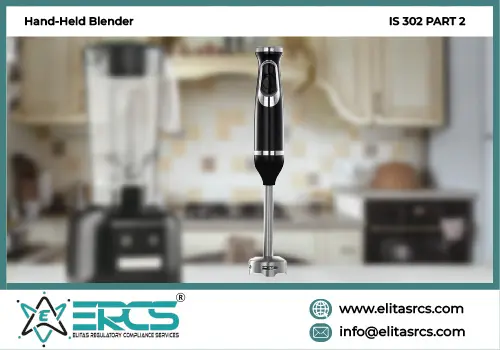
The hand held blender is an essential kitchen appliance that can be used to blend, puree, or emulsify food and other ingredients directly within a pot. Manufacturers of the Handheld Blender are required to obtain ISI/BIS Certification before selling their products within the Indian Marketplace. BIS Licensing establishes standards for safety and performance for end users. The Indian Standard 302 (Part 2/Section 14) requires that blenders be manufactured to high-quality standards and the reliability of the product.
The BIS certification process entails an application submission, factory inspection, and product sample testing. The manufacturer will then receive the BIS Certification and the letter to use the ISI Mark on their product. This compliance process will take time, so be sure you have the Top BIS Consultant to assist you with the process. ERCS Private Limited provides expert guidance and helps manufacturers through the application process.
Overview of Hand-held Blender under BIS Schem- I
The Hand-held Blender is a type of kitchen appliance found in many households. It helps make soups, sauces, smoothies, and pureed foods. The hand-held (immersion) blender has a small motor with a removable shaft, which contains blades. With its versatile design and ease of use, it is ideal for everyday cooking and for creating more elaborate culinary dishes.
The BIS Certification for hand-held blenders under the IS 302 (Part 2/ Section 14) ensures that appliances meet essential safety and efficiency standards for everyday use. This certification guarantees compliance with electrical and mechanical safety requirements, which helps reduce the risks of electrical hazards, fire, and injury.
Key Highlights for IS 302 (Part 2/ Section 14)
The main specification under IS 302 (Part 2 / Section 14) is as follows:
- Scope: This standard includes immersion and hand-held blenders and other similar home kitchen equipment.
- Electric shock protection: All live components of the equipment shall be protected and dead (not live) and shall have adequate insulation.
- Moisture protection: The equipment shall be tested for its ability to withstand the ingress of water (i.e., water splash or short-term immersion).
- Mechanical safety: The equipment shall undergo shock/drop impact testing to verify if the mechanical parts (i.e., motor and blade mechanism) will remain intact.
- Safety and durability: This includes testing the reliability of the motor under overloading or blockage conditions and ensuring that the motor does not overheat during these operations.
- Fire resistance: All components of this equipment shall be tested for their ability to withstand temperature (heat) and to prevent combustion of any part during operation.
Benefits of BIS Certification for Hand-held Blender
Get the advantage of obtaining handheld blenders Certification under BIS:
- Legal Requirement: All hand-held blenders sold in India must be certified by BIS to operate legally.
- Increased Safety and Quality Assurance: The blender has gone through a stringent safety testing process and meets statutory requirements, thus reducing the risk for consumers from electrical shock, overheating, and insulation failures.
- Increased Confidence with Consumers: Consumers trust the ISI mark to determine the product’s reliability; therefore, they are more likely to choose products with the ISI mark over those without it.
- Increased Marketability: Being certified by (BIS), the product is perceived as being of high quality, providing manufacturers with a competitive advantage and increased brand value.
- Reduced Operating Losses: The use of compliant manufacturing processes reduces the amount of waste and rejected products in the manufacturing process.
Documents Required for ISI Mark on IS 302 (Part 2/ Section 14)
The following items are necessary documents required for obtaining BIS Certification:
- Completed Application Form (Application V)
- Factory Registration/Formation certificate (e.g. MSME/Partnership Deed)
- Proof of Address for Manufacturing Unit (e.g. Lease Agreement, Electricity bill).
- Details and Identification of Authorised Signatory
- Trademark Registration Certificate (if any)
- Details of the Product Specifications (drawings, components used, materials of manufacture).
- Detailed manufacturing process flow chart
- List of Machinery & Installed Capacity
- List of Raw Materials used, and certificates of conformance
- Identification document of Authorised Signatory and authorisation letter
- Quality Control Documentation and Inspection Procedures.
Applicable Test Parameters for Hand-held Blender IS 302 (Part 2/ Section 14)
The testing parameters for Hand-held Blenders include measuring the electrical input/currents, insulation resistances, dielectric strength, and heating conditions:
- Marking/Instructions: Check that there are the correct labels and safety signs along with proper instructions for the users.
- Protection of Users from Accessing Live Parts: Check that the appliance is designed in such a way as to ensure no user can access live parts.
- Power input/currents: They must remain within the appliance's rated limits.
- Heating test: The appliance must not reach an excessive temperature once operated at full load using a combination of carrots and water.
- Moisture resistance: Will be tested (will withstand water splashes or spills).
- Abnormal usage: Testing will simulate conditions that may occur if the motor becomes blocked, misused, or the use of improper ventilation is used, which could result in a fire.
Process of BIS Certification of Hand-held Blender
To obtain BIS Certificate, a manufacturer must complete a few steps, such as:
- The application process is initiated by the manufacturer via website registration
Preparation of the application/documentation by the manufacturer - Submission of the samples to be tested at a BIS-approved testing laboratory
- The manufacturer undergoes an assessment/inspection of the manufacturing facility/production process, including quality control during production
- Issuance of the Manufacturing License to the manufacturer by the BIS, and allowing them to apply the Standard Mark to their product.
Both Indian and foreign manufacturers must follow the process to obtain BIS certification:
BIS Certification Process for Indian Manufacturers
BIS Certification Process for Foreign Manufacturers
BIS Certification Checklist Points for ISI Mark on Hand-held Blender
Here is a list of the points to be taken into account while working with ISI Marking for Hand-held Blenders (Bureau of Indian Standards):
- Applicable Standard Compliance: The product must conform to IS 302 Part 1 & Part 2/Sec 14 as a requirement for Safety.
- Authorised Manufacturer: Only the manufacturer may apply for an ISI license (not the trader/importer)
- Factory Inspection: A complete factory audit will be conducted by the Bureau of Indian Standards.
- In-house Testing Facility: Obtain and maintain an appropriate range of testing equipment, in accordance with the required standards.
- Product Testing: The samples for testing must be taken to a Bureau of Indian Standards laboratory.
- Quality Control Measures: Consistent checks for Quality at the time of production.
- Marking/Labelling: Adequate marking/labelling must be made in accordance with Bureau of Indian Standards requirements on both the product itself and its packaging.
BIS Certification Fees in India for IS 302 (Part 2/ Section 14)
Go through the table to know the cost of BIS Certification India for IS 302 (Part 2/ Section 14):
|
S No. |
Particular |
Amount (INR) |
Remarks |
|
1. |
Application Fee |
1000 |
To be paid directly to BIS |
|
2. |
Audit Fee |
7000 |
To be paid directly to BIS |
|
3. |
License Fee |
1000 |
To be paid directly to BIS |
|
4. |
Sample Testing Fee |
As Applicable |
To be paid directly to BIS (Testing charges vary from product to product and lab to lab.) |
|
5. |
Minimum Advance Marking Fee |
As per the actual |
To be paid directly to BIS (Marking fee varies as per Indian Standard) |
|
6. |
Renewal Fee |
1000 |
To be paid directly to BIS |
|
7. |
Inclusion Fee |
5000 |
To be paid directly to BIS |
|
8. |
ERCS Pvt Ltd Service Fee |
Please contact info@elitasrcs.com |
|
|
Remarks |
Including all the taxes |
||
Why Choose ERCS Private Limited for BIS Licensing of Hand-held Blender?
ERCS Pvt. Ltd., as the Top BIS Consultant, offers comprehensive and self-contained BIS Certification Services for hand-held blenders (IS 302 Part 2/Section 14) to provide expert assistance in areas such as documentation, testing and regulatory compliance.
- ERCS also helps manufacturers navigate the mandatory ISI Mark Certification process, which involves obtaining certification for their hand-held blenders against the required Indian Standard Specifications (IS 302 Part 2/Section 14).
- They can assist in every phase of the certification process (including preparing documentation, coordinating all activity with BIS Officials, and coordinating all testing of samples), which will greatly reduce the risk of having a certification application rejected.
- ERCS has extensive experience in understanding and applying Indian safety standards; therefore, they can ensure that the products will comply with electrical and thermal hazard protection requirements.
- ERCS is a growing consultancy which provides services on a prompt and timely basis and helps to obtain the BIS license required to sell legally within India as quickly as possible.