BIS Certification for Composite Cement IS 16415
Category: BIS Certification
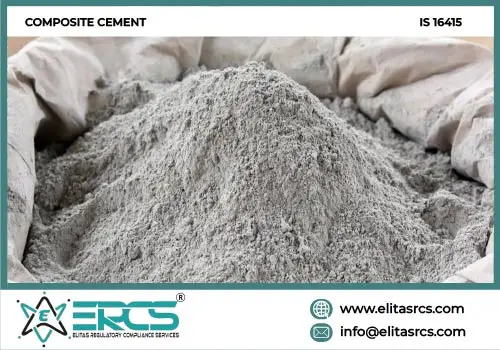
Are you a manufacturer of Composite Cement? You must obtain the ISI mark to enter the Indian market under the Bureau of Indian Standards Act, 1986 (63 of 1986). If you don’t have approval for the product, you cannot comply with Indian Standards, and that could be a reason for your business failure. The ISI mark helps to build trust in front of customers. In 2026, many people check the mark before buying any products.
This BIS compliance helps to ensure safety and standard quality. A BIS License is the essential approval to build trust in the market. Foreign and Indian manufacturers who want to sell products in the Indian market must obtain BIS certification under the latest BIS guidelines in 2026. Also, ERCS Private Limited is available here to handle your entire process from application to approval, and it comes under the top BIS consultants in India. You can trust us to make your products certified.
Before getting a license, you need to check whether your product comes under the BIS mandatory list and is eligible for certification. Composite cement is made from a combination of ingredients and additives. It has increased performance, sustainability, adaptability, and affordability, which makes it a great choice for various contemporary building projects. Used for various purposes widely, composite cement is a popular choice among people who need something durable and reliable.
With the advent of rising innovations and demands for newer architectural styles for contemporary homes and spaces, there are recurring construction and styling demands that come under IS 16415. To obtain BIS Certification, read the details that we have shared below on this page. That would be helpful for your certification journey.
Key Highlights for IS 16415
IS 16415 is the Indian Standard that specifies the requirements for Composite Cement. This standard focuses on ensuring consistent quality and performance in construction materials.
Important highlights include:
- Specification for Composite Cement used in construction
- Guidelines for composition and permissible materials
- Requirements related to strength, durability, and performance
- Quality control measures during manufacturing
- Testing methods for evaluating product quality
- Mandatory compliance for manufacturers under BIS certification
This standard helps maintain uniform quality across the construction industry and ensures that composite cement products meet national safety and performance expectations.
BIS QCO (Quality Control Order) Update for Composite Cement in 2026
The Government of India issues Quality Control Orders (QCOs) to ensure that certain products meet specific quality standards before being sold in the market. Composite Cement falls under such regulatory requirements. Under the latest BIS regulations and QCO updates in 2026, manufacturers must obtain BIS Certification with the ISI Mark before selling or distributing composite cement in India.
Key points of the QCO include:
Mandatory BIS certification for composite cement manufacturers
- Compliance with IS 16415 standard
- Restriction on manufacturing, selling, or importing non-certified products
- Requirement for manufacturers to maintain proper testing and quality control
- Failure to comply with these regulations may result in penalties, product restrictions, or legal action.
ISI Mark Certification Benefits for Composite Cement
Obtaining the ISI Mark Certification for composite cement offers several advantages to manufacturers and consumers.
Some major benefits include:
1. Legal Market Access: Manufacturers can legally sell their products in the Indian market after obtaining BIS certification.
2. Consumer Trust: The ISI mark assures customers that the product meets approved safety and quality standards.
3. Quality Assurance: BIS certification ensures that the product undergoes proper testing and follows standardized manufacturing practices.
4. Competitive Advantage: Certified products gain better credibility in the market compared to non-certified products.
5. Government Compliance: Manufacturers remain compliant with regulatory requirements under BIS and Quality Control Orders.
Applicable Test Parameters for Indian Standard IS 16415
To obtain BIS certification, composite cement must pass several laboratory tests as specified in IS 16415. These tests verify the quality, performance, and safety of the product.
Some of the major test parameters include:
- Fineness test
- Compressive strength test
- Setting time (initial and final)
- Soundness test
- Chemical composition analysis
- Loss on ignition
- Insoluble residue
- Residue on sieve
These tests are conducted in BIS-recognised laboratories to ensure that the product meets the required standard before certification approval.
BIS Certification Process for Composite Cement (IS 16415)
Manufacturers must follow a structured process to obtain BIS certification for composite cement.
BIS Certification India for Indian manufactueres
BIS FMCS Certification for Foreign Manufactueres
What is Mandatory Certification for Composite Cement in 2026?
Mandatory certification means that manufacturers must obtain BIS certification before selling their product in the Indian market.
In 2026, composite cement falls under mandatory certification requirements due to its importance in construction safety and infrastructure development.
Under these regulations:
- Only BIS-certified composite cement can be manufactured, sold, or imported in India.
- Manufacturers must comply with IS 16415 standards.
- Products must carry the ISI mark on packaging and labelling.
This mandatory certification ensures that only quality products are used in construction projects across the country.
Why Choose ERCS Private Limited for IS 16415?
Obtaining BIS certification can be a complex and technical process. ERCS Private Limited provides expert support to help manufacturers complete the certification process smoothly.
Reasons to choose ERCS Private Limited:
- Professional guidance for BIS certification
- Support for documentation and application filing
- Assistance with product testing and compliance
- End-to-end consultancy from application to approval
- Experience handling various BIS certification projects
The team ensures that manufacturers can obtain their BIS license efficiently while meeting all regulatory requirements.
Conclusion
Composite Cement plays an important role in modern construction and infrastructure development. To ensure quality, safety, and reliability, manufacturers must comply with IS 16415 standards and obtain BIS certification with the ISI mark. With mandatory certification requirements in 2026, manufacturers need to follow BIS guidelines and maintain proper quality control. By obtaining BIS certification, companies can build customer trust, ensure regulatory compliance, and expand their presence in the Indian market.