BIS Certification for Tin Ingot IS 26
Category: BIS Certification
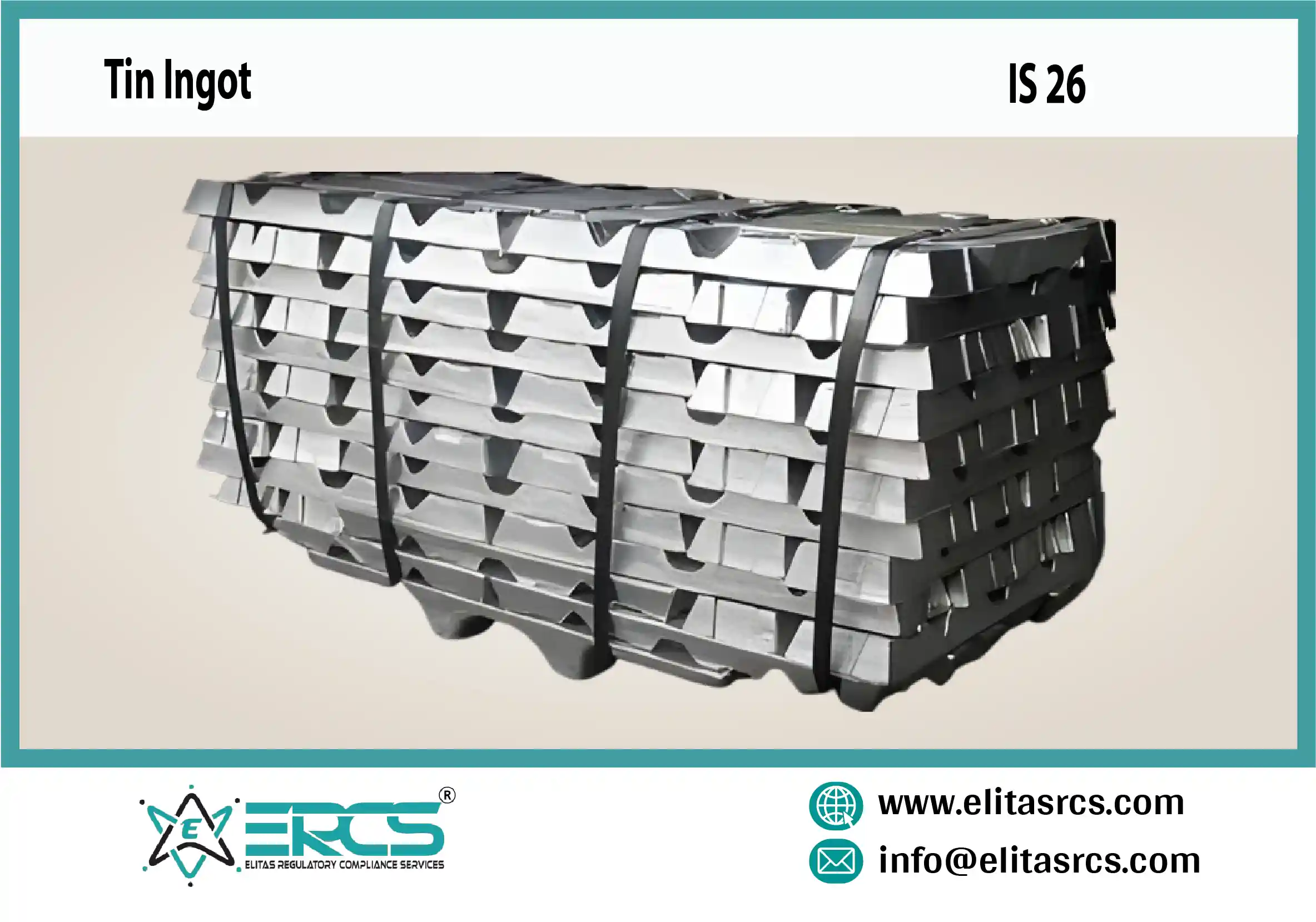
Under IS 26, the Bureau of Indian Standards (BIS) governs the quality requirements for tin ingots in India. This standard requires all processes involved in manufacturing tin ingots, along with quality specifications, particular test methods, and packing requirements.
For Tin Ingot, BIS certification is now compulsory according to the latest Quality Control Order issued by the Ministry of Mines. Tin ingot is widely used to produce alloys, solder, and coating materials. The certification also leads to consumer confidence, as it ensures the product adheres to high-quality levels.
Overview of Tin Ingot Certification
Tin ingots are essential materials in several industries, from electronics and soldering to plating and coating applications. Tin purity and quality thus become utmost for high-performance materials being produced for increased demand.
In India, the Bureau of Indian Standards regulates quality under the Indian Standard IS 26 for tin ingots. This standard provides specifications of tin ingots, which manufacturers have to meet in terms of quality and safety.
Tin is, thus, an inorganic, high-purity silver-white metallic element generally used for soldering, plating, and many industrial applications because of its ductility and very good corrosion resistance.
Key Specification of IS 26
The specifications for refined tin ingots made from primary and secondary tin-bearing sources are outlined in IS 26. There are primary provisions you can check:
- Scope and Application: IS 26 covers refined tin ingots manufactured by a variety of refining processes, such as fire, vacuum, and electrolytic refining. It applies to both primary and secondary tin sources, thus granting a certain flexibility to the manufacturer.
- Classification and Grades: The standard classifies tin ingots into six grades, depending upon minimum tin content:
- Sn99.75
- Sn99.85
- Sn99.90
- Sn99.93
- Sn99.95
- Sn99.99
Each grade meets the threshold of chemical composition requirements but offers varied limits on impurities such as Sb, As, Bi, Cu, Pb, and Fe.
- Chemical Composition: The chemical composition of each grade is outlined in Table 1 of the standard. The analysis of chemical composition can be conducted using methods specified in IS 1940 or other recognized instrumental methods.
- Manufacturing Process: A number of techniques, refining, vacuum refining, and electrolytic procedures, can be used to create the tin ingots. The standard provides flexibility in the sourcing of raw materials by permitting the use of both primary and secondary ore.
- Form and Mass of Ingots: Unless a certain form and weight are agreed upon with the buyer, IS 26 gives the supplier choice over the ingots' shape and mass. Each ingot typically weighs about 25 kg, with a tolerance of ± 1.5 kg.
- Dimensions and Tolerances: Specific parameters for measuring and the range of variation acceptable for the product or material being specified.
- Material Properties: Chemical composition and physical properties (e.g., hardness, tensile strength) and any other pertinent characteristics.
- Performance Criteria: How the product/material is expected to perform under specific conditions (e.g., load capacities, corrosion resistance, insulation properties).
- Design Specifications: Details of design via drawings, schematics, or any other means of imparting visual information.
BIS Certification Scope of Tin Ingot
The requirements for the Virgin tin ingot form are covered by this standard. However, IS 4280: 1970 "Refined secondary tin (first revision)" covers the standards for refined secondary tin, which are not addressed in this standard.
BIS Quality Control Order for Tin Ingot IS 26
As per the Bureau of indian standards quality control order for tin ingot, to be adopted from 2025, any tin ingot offered for sale in India should have been produced according to the Indian Standard IS 26:2024 and should bear the BIS Standard Mark.
The Tin Ingot (Quality Control) Order, 2025, is another name for this order. Six months from the date this notification was published, this order will become operative. The items listed in column (1) of the table below are subject to this order; however, items intended for export are exempt.
By Scheme 1 of Schedule II of the Bureau of Indian Standards (Conformity Assessment) Regulations, 2018, the products or items listed in column (1) of the table must meet the corresponding Indian Standard listed in column (2) of the table and must bear the Standard Mark under a license from the Bureau of Indian Standards.
Process for Getting BIS Certification for Tin Ingot IS 26
The following procedure needs to be followed to obtain the BIS certificate for your product:
- Filing of the Application: Manufacturers have to register on the BIS portal first and then apply for a license by filling out the application form.
- Preparation of Documentation: It comprises getting all the documents such as factory license, quality control plans, specifications of raw materials, etc.
- Testing in Laboratories: Samples of the tin ingots need to be sent to a BIS-recognized laboratory for chemical composition testing.
- Inspection of Factories: BIS officers inspect the production process, quality control system, and layout setup in the factory.
- Granting of License: After the license inspection, checking, and verification of test reports, BIS grants the license to use the Standard Mark to indicate that the tin ingots comply with IS 26.
The certification can be obtained and certified for both Indian and foreign manufacturers:
- BIS Mark Certification Procedure for Indian Manufacturers
- BIS Mark Certification Procedure for Foreign Manufacturers
What are the timelines for Tin Ingot BIS Certification?
India offers several BIS certification periods for different types of producers. They include BIS Certifications to Indian Manufacturers, issued in the general case within 30 days, and BIS Certifications for Foreign Manufacturers, released within 180 days.
Documents Required Under BIS Certification of Tin Ingot IS 26
Below we have mentioned the list of documents required for BIS Certification of Tin Ingot IS 26:
- Application
- Application Form for domestic manufacturers and Application Form for foreign manufacturers.
- The application should be filed online through the portal of BIS Manakonline.
- Factory and Product Details
- Process flow chart of manufacturing tin ingots.
- Details of raw material, production capacity, and source of raw tin.
- Factory layout plan or photographs.
- Test Equipment List
- List of in-house testing equipment as per IS 26.
- Calibration Certificates of testing equipment (either from NABL or laboratories recognized by BIS).
- Test Reports
- Internal Test Reports or those from a third-party testing lab for tin ingots.
- Must certify conformance to chemical and physical requirements of IS 26 (e.g., purity, hardness, appearance).
- Quality Control Documents
- Quality assurance manual, procedures.
- Records of quality control and corrective actions.
- Legal Documents
- GST registration certificate (for Indian manufacturers).
- Certificate of registration or incorporation of the company.
- Authorization letter of the signatory.
- For Foreign Manufacturers only
- Appointment Letter of the Authorized Indian Representative (AIR).
- KYC documents of AIR (PAN, Aadhaar, etc.).
- Undertaking by AIR accepting the responsibility.
Cost of Product Certification for Tin Ingot
Go through the table to know the cost of BIS Certification for IS 26:
|
S No. |
Particular |
Amount (INR) |
Remarks |
|
1. |
Application Fee |
1000 |
To be paid directly to BIS |
|
2. |
Audit Fee |
7000 |
To be paid directly to BIS |
|
3. |
License Fee |
1000 |
To be paid directly to BIS |
|
4. |
Sample Testing Fee |
As Applicable |
To be paid directly to BIS (Testing charges vary from product to product and lab to lab.) |
|
5. |
Minimum Advance Marking Fee |
As per actual |
To be paid directly to BIS (Marking fee varies as per Indian Standard) |
|
6. |
Renewal Fee |
1000 |
To be paid directly to BIS |
|
7. |
Inclusion Fee |
5000 |
To be paid directly to BIS |
|
8. |
ERCS Pvt Ltd Service Fee |
Please contact info@elitasrcs.com |
|
|
Remarks |
Including all the taxes |
||
How ERCS Can Help You In Obtaining BIS Certification?
ERCS, as a BIS consultant, creates a bridge between the manufacturer and the BIS officials, aiding the client through the entire process of the BIS procedure. This includes verification of product applicability and final approval. There is, indeed, an endless need for experts in the documentation field, especially to safeguard the interests of their clients from losing out on product certifications through complex procedures.
Thus, it becomes a guide through the BIS certification process, which includes the identification of applicable Indian Standards, the preparation of documentation, and knowledge of requirements for different categories of products. They provide assistance to solidly prepare documents required for BIS certification and ensure that they are complete with no errors that will delay the certification process. This makes ERCS the best BIS consultants in India.