BIS Certification for Thin-Walled Plain Bearings IS 10203
Category: BIS Certification
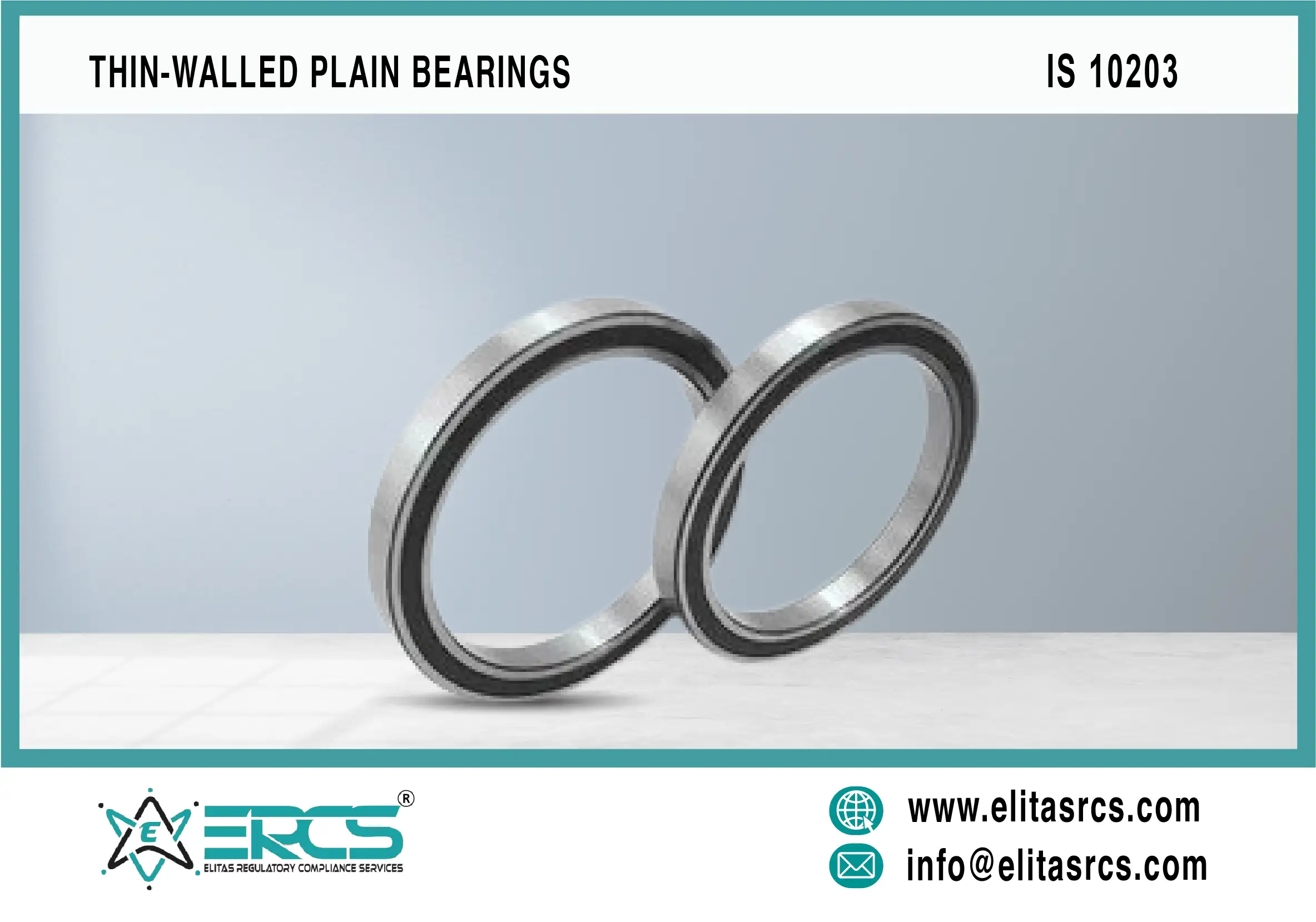
Thin-walled plain bearings are critical parts for use in engines, compressors, gearboxes, turbines, and a multitude of machinery where low-friction movement and load support are necessary. These bearings are usually used in high-speed, high-pressure applications and must work reliably when made as thin as possible and as light as possible.
With their critical use in reliability applications, the need to maintain dimensional tolerances, material consistency, and load-bearing capacity is important. This is where IS 10203 Thin-walled plain bearings play a key role. The Bureau of Indian Standards (BIS) requires that thin-walled plain bearings be BIS-certified by IS 10203. The QCO means that Manufacturers, Importers, and Traders will now be required to have IS (Indian Standards) compliance regarding bearings before entering the Indian markets. Let’s delve deeper to know more.
Overview of Thin-Walled Plain Bearings Certification under BIS
A Thin-Walled Plain Bearing is a moderately complex component that reduces friction and wear between moving parts in engines, transmissions, compressors, and other rotating machines. Note that plain bearings encompass a wide array of components used as bearing systems, with each of them characterized by a plain bearing lining bonded to a thin metallic or composite shell that ultimately allows for a lower clearance fit relative to conventional/standard bearing systems. Common bearing materials used for thin-walled plain bearings include aluminum alloy, copper-lead alloy, and miscellaneous anti-friction linings.
Most commonly associated with thin-walled plain bearings would be those designed in a half-bearing configuration. While the use of thin-walled plain bearings isn't limited to automotive applications, they are widely used in automotive engines for crankshaft and connecting rod support. Thin wall designs are used because of their ability to have tighter clearances, lower weight, and thermal conduction capabilities when compared to standard/solid bearing designs. Thin-walled plain bearings are ideal for high-speed and high-load applications.
BIS Scope of Thin-Walled Plain Bearings Certification under BIS
BIS registration for thin-walled plain bearings, specifically under IS 10203, is mandated for manufacturers in India. This specifies style, quality, safety, and compliance with the national benchmark. The specification attests that the bearings meet the requirements of the IS 10203 specification and that they are suitable for use in machinery.
BIS Quality Control Order (QCO) for Thin-Walled Plain Bearings: IS 10203
The Bureau of Indian Standards (BIS) Quality Control Order (QCO) applies to thin-walled plain bearings and is a mandatory certification. The goal of this QCO, which we can often associate with the IS 10203 standard, is to ensure the quality, safety, and dependability of thin-walled plain bearings. The QCO prevents poor quality products from entering the market and enables the development of domestic manufacturing in this product area. The QCO requires these bearings to meet IS 10203 and have a Standard Mark (ISI Mark) to do so under a BIS license.
Key Specification of IS 10203
IS 10203 outlines basic technical criteria for thin-walled plain bearings that are used primarily in internal combustion engines and in other types of rotating machinery. It includes the material, design, performance, and inspection criteria to ensure quality, safety, and interchangeability.
1. Types of Bearings Subscribed
- Thin-walled plain bearings, half bearings
- Commonly used in automotive engines (e.g., crankshaft, connections)
- With or without flanges
- With steel backing and a bearing layer (bimetal or trimetal)
2. Materials
- Back layer: Mild steel or low carbon steel
- Bearing layer materials:
- Copper-lead alloy
- Lead-bronze
- Tin-aluminum
- Sintered or bonded anti-friction layers
Optional overlay coatings (lead-tin or polymer layers)
3. Dimensional Criteria
- Wall thickness tolerance
- Bearing width and diameter
- Concentricity and roundness
- Finish and quality of backs and running surface
- Chamfering and radii at the ends of the bearing
4. Physical and Mechanical Properties
- Bond strength between the bearing layer and backing (peel or bond test)
- Hardness of bearing layer (BHN or HV)
- Fatigue strength for high loads
- Corrosion resistance
- Oil clearance and fit tolerances (precision requirements for engine use)
5. Performance Criteria
Must withstand:
- High loads
- High temperatures
- Dynamic and cyclic loads
- Must show:
- Good embeddability (cosmetic ability to absorb small debris)
- Conformability (ability to conform to shaft irregularities)
6. Inspection
- Visual Inspection: No cracks, pits, or deformations
- Dimensional Check: Using calibrated gauges
- Bond Test: Peel strength test or ultrasonic examination
- Hardness Test: Vickers or Brinell test
- Surface Finish: Ra value as per the standard
- Fatigue Test (if required for high-performance applications)
Basic Steps to Obtain BIS Certification for Thin-Walled Plain Bearings
Essential Steps to Achieve BIS Certification for Thin-walled Plain Bearings.
1. Application:
- To make an application for Bureau of Indian Standards (BIS) certification for thin-walled plain bearings, do the following:-
- Register and log on to the BIS website.
- Select the license tab of certification as appropriate, then apply for a license.
- Once complete, carry out your application and ensure all the information requested is in record.
- Ensure you check off the checklist of the documents that you will need to upload.
2. Documents:
- Upload documents as requested, including product test reports.
- Upload records and any documents without errors and as complete as possible.
3. Factory Audit:
BIS will send auditors to conduct a factory audit to assess your company's production and property controls.
4. Sample Testing:
- Samples from your product will be collected, and your unique samples will be collected and then sent to an accredited laboratory with the BIS accreditation for testing.
- The outcome of this testing will depict whether you meet India's Indian Standards for thin-walled plain bearings, such as IS 10203.
5. License:
If the factory audit is successful, and then product testing has been successfully completed for thin-walled plain bearings, then BIS will issue your certification license.
6. Surveillance:
BIS will continue to perform the surveillance of your factory and will continue to collect product samples to test and monitor your compliance.
7. reCM License:
BIS will reissue your license via test and audit.
The BIS certification for both Indian & foreign manufacturers:
- BIS Mark Certification Process for Indian Manufacturers
- BIS Mark Certification Process for Foreign Manufacturers
What are the Timelines for Primary Lead BIS Certification?
India has different timelines for BIS certification for different types of producers. They consist of BIS Certifications to Indian Manufacturers, which normally take 30 days, and BIS Certifications to Foreign Manufacturers, which are usually provided in 180 days.
BIS Certification Cost for IS 10203
Go through the table to know the cost of BIS Certification for IS 10203:
|
S No. |
Particular |
Amount (INR) |
Remarks |
|
1. |
Application Fee |
1000 |
To be paid directly to BIS |
|
2. |
Audit Fee |
7000 |
To be paid directly to BIS |
|
3. |
License Fee |
1000 |
To be paid directly to BIS |
|
4. |
Sample Testing Fee |
As Applicable |
To be paid directly to BIS (Testing charges vary from product to product and lab to lab.) |
|
5. |
Minimum Advance Marking Fee |
As per actual |
To be paid directly to BIS (Marking fee varies as per Indian Standard) |
|
6. |
Renewal Fee |
1000 |
To be paid directly to BIS |
|
7. |
Inclusion Fee |
5000 |
To be paid directly to BIS |
|
8. |
ERCS Pvt Ltd Service Fee |
Please contact info@elitasrcs.com |
|
Why Choose ERCS Pvt. Ltd.?
ERCS Pvt. Ltd. best BIS Consultant in India for manufacturers, ensuring their products meet applicable standards. ERCS has the experience gained from over 100 projects to ensure all documentation submitted complies with the relevant standards and requirements as governed by BIS. As a BIS agent in India, ERCS provides a host of services from product certification, testing, training, auditing, and compliance that show added value to the producer/importer.
ERCS is with you throughout the BIT certification process and beyond. ERCS ensures BIS products comply with Indian standards to sustain and maintain BIS certification. ERCS can provide assistance to the producers and importers throughout the entire process from pre-submission to post-certification."