BIS Certification for Cooking Ranges, Hobs, Ovens, and Similar Appliances IS 302 (Part 1)/IEC 60335-1
Category: BIS Certification
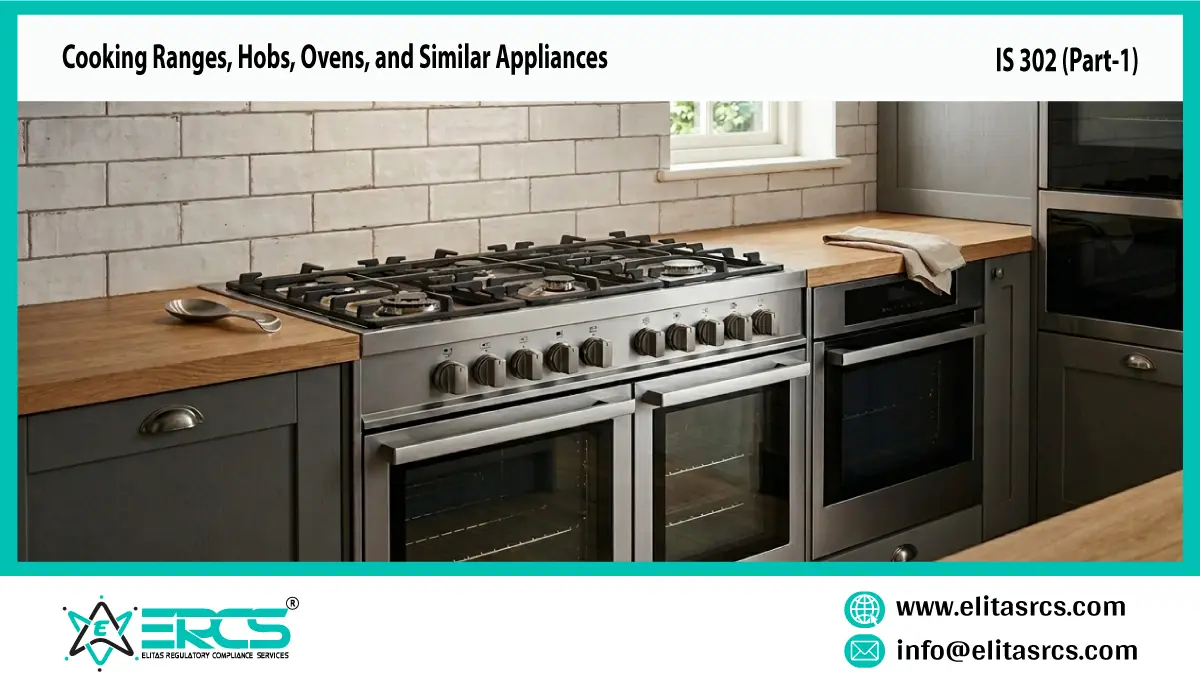
If you manufacture, import, or sell electric cooking appliances in India, BIS certification under IS 302 (Part 1) is mandatory. Under the Safety of Household and Similar Electrical Appliances (Quality Control) Order, 2025, no cooking range, hob, or oven can be legally manufactured, imported, or sold in India without a valid ISI mark. This guide covers everything you need to know, from what IS 302 (Part 1)/IEC 60335-1 requires, to documents, timelines, costs, and how to get certified without unnecessary delays.
What Are Cooking Ranges, Hobs, and Ovens?
These three appliance types are defined differently under Indian standards:
- Cooking ranges combine a cooktop and an oven in a single unit, used in both residential and commercial kitchens.
- Hobs are standalone cooktop surfaces built into a kitchen counter, without an oven component.
- Ovens are enclosed heating units designed for baking, roasting, and grilling.
All three fall under IS 302 (Part 1)/IEC 60335-1 and require BIS certification before they can be sold in India, whether they are domestically manufactured or imported.
Key Highlights for IS 302 (Part 1)/IEC 60335-1 for Cooking Ranges, Hobs, Ovens, and Similar Appliances
Major Highlights for IS 302 (Part 1)/IEC 60335-1 cooking appliances:
- Mandatory Registration: All cooking appliance manufacturers and sellers must register with BIS and display the ISI mark.
- Safety: Requirements for reducing hazards include reducing fire hazards due to electrical equipment, reducing shock hazards, and reducing overheating risks.
- Applicability: Electric, domestic or commercial cooking ranges, hobs and ovens.
- Globally Aligned: Internationally Harmonised Standard based on IEC 60335-1 to give a baseline for worldwide acceptance in cooking appliances.
- Testing Requirements: Testing of different cooking appliance components for thermal resistance (high temperature), water resistance, and mechanical integrity (strength).
Benefits of BIS Certification for IS 302 (Part 1)/IEC 60335-1 cooking appliances,
Reasons to Obtain BIS Certification
- It is required by law: Under the 'Safety of Household and Similar Electrical Appliances (Quality Control) Order, 2025', electrical cooking appliances must obtain BIS certification before being sold in India; therefore, all electrical cooking appliances sold in India must conform to all Indian safety requirements.
- Builds consumer confidence and safety: Consumers can see that a product has an ISI seal of approval, proving that it has passed safety and quality inspections. The ISI seal assures consumers that the products were thoroughly tested to ensure both electrical safety and proper mechanical integrity.
- Provides manufacturers with access to the market and a competitive advantage: Only BIS-certified products are legally permitted for sale in India. So this helps manufacturers distinguish themselves from lower-quality, non-certified competitors, giving them an advantage.
- Reduces the risk of liability associated with defective products: With BIS certification, manufacturers are subject to rigorous testing and inspection processes throughout the manufacturing process.
- Assures high quality: Products that obtain BIS certification are subjected to testing against strict requirements outlined within IS 302 (Part 1)/IEC 60335-1 to ensure that products will withstand frequent use, provide an efficient means of performing daily functions and operate reliably.
Documents Required for ISI Mark Cooking Ranges, Hobs & Ovens
Important documents include a Manufacturing Process Flowchart, Quality Control Manual, and BIS-accredited lab test reports:
- Company/Factory Documents
- Layout map/site plan of the factory premises.
- Detailed manufacturing process flowchart and a list of production machinery.
- Quality Control Manual and in-house testing equipment list.
- Test reports from a BIS-accredited laboratory confirming compliance with the relevant IS standards.
- List of raw materials and their test certificates.
- Drawings and technical details of the appliance (cooking range/hob/oven).
- Aadhar and PAN card of the proprietor/director.
For Foreign Manufacturers:
- Authorised Indian Representative (AIR) appointment letter
- Declaration of conformity to Indian Standards
Note: Incomplete documentation is the single biggest reason for delays and rejections. Having all documents in order before submission can cut your timeline by 2–3 weeks.
Applicable Test Parameters for IS 302 Part-1
Key Test Parameters of Domestic Cooking Appliances as per IS 302 (Part 1)/IEC 60335-1:
- Marking & Instructions: Durability and provision of safety instructions on markings used throughout the appliance.
- Protection Against Electric Shock: No live parts shall be readily accessible.
- Input Power & Current: Confirmation of nominal power and current.
- Heating & Temperature Rise: No parts (knobs, handles, housing) will become excessively hot during use.
- Leakage Current & Insulation Resistance: Must maintain electrical safety while operating the appliances under normal conditions.
- Moisture Resistance: The appliance's function must be maintained following accidental water or drink spillages to ensure a safe working environment while still compliant with electrical safety requirements.
- Abnormal Operation: Must remain safe when operated under abnormal conditions as set forth by this standard (e.g., thermostat malfunction, blocked cooling fan).
- Mechanical Strength/Stability: Assurance that door hinges/shelves remain structurally sound/stable.
- Resistance to Heat/Fires: Must comply with material flammability tests such as glow wire tests.
- Components: Built-in component switches/thermostats/heaters should perform properly in accordance with this standard.
BIS Certification Cost and Timeline for Cooking Appliances (2026)
Timeline:
BIS Certification for Indian manufacturers: approximately 35–50 days (documentation-dependent).
BIS certification for Foreign manufacturers: 4–6 months (including AIR appointment and coordination).
Cost:
The total cost varies based on product type, number of models, and laboratory testing fees. To get an accurate cost estimate for your specific cooking appliance, contact ERCS Private Limited for a consultation.
BIS Certification Process of Cooking Similar Appliances
This is a step-by-step procedure that must comply with Indian standards when you are either an Indian or a foreign manufacturer looking to sell your products within India:
- File an Application: The very first step you need to take is to file an application at your respective BIS regional office.
- Compile Documents: You must also provide all necessary testing documents with your application.
- Testing in Laboratories: The next step is to have all tests conducted by a BIS-certified laboratory in accordance with the relevant Indian standard.
- Inspection of the Manufacturing Process: A BIS auditor will visit to audit your samples and ensure you have provided all necessary documentation.
- Issuance of the Licence: The final step is obtaining an ISI Licence, once you have passed all testing and provided sufficient evidence of compliance with all requirements.
Who Needs BIS Certification for Cooking Appliances?
BIS certification under IS 302 (Part 1)/IEC 60335-1 applies to:
- Indian manufacturers producing electric cooking ranges, hobs, or ovens for the Indian market
- Foreign manufacturers exporting these appliances to India must appoint an Authorised Indian Representative, or AIR)
- Brand owners selling cooking appliances under private labels
- Importers and traders who are responsible for verifying that their products carry a valid ISI mark
Why Choose ERCS Private Limited for BIS Certification of IS 302 (Part 1)?
ERCS Private Limited is a specialist BIS/ISI certification consultancy with over 1,500 successful certifications completed across 30+ locations in India. We help both Indian and foreign manufacturers get their cooking appliances certified without the typical delays and back-and-forth that come with incomplete applications.
What we handle for you:
- Full document preparation and review before submission
- Coordination with BIS-accredited testing laboratories
- Factory inspection readiness support
- Application filing and BIS correspondence
- End-to-end support from the first document to the final licence
Whether you are certifying a single product model or an entire range of cooking appliances, ERCS manages the entire process so you can focus on your business.
Ready to get your cooking range, hob, or oven BIS certified? Contact ERCS today for a free consultation and cost estimate.