BIS Certification for Machinery and Electrical Equipment Safety (Omnibus Technical Regulation)
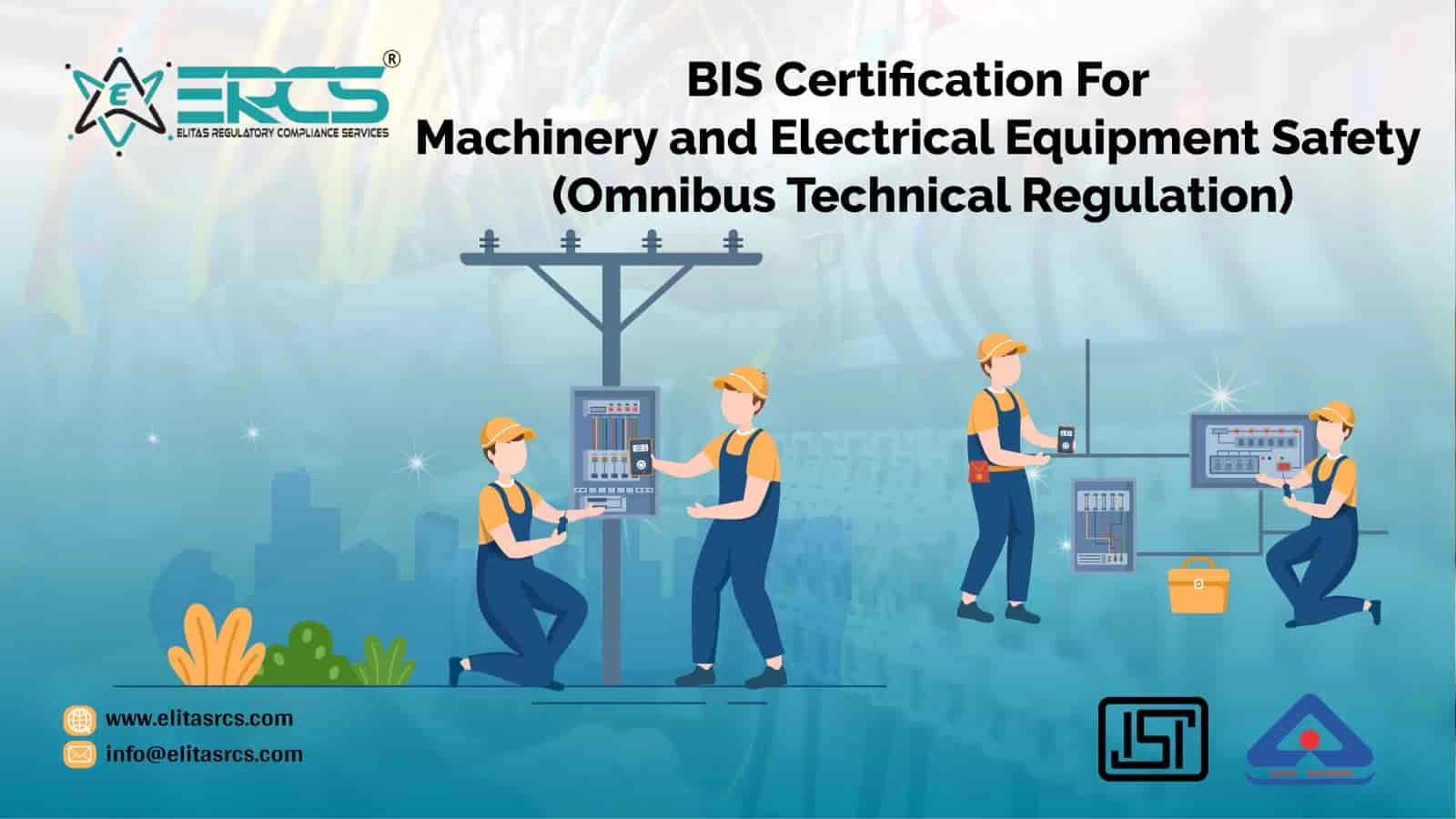
On August 28, 2024, the Ministry of Heavy Industries released an important regulation regarding the safety and quality of products under Scheme X of the Conformity Assessment Regulations, Machinery and Electrical Safety (Omnibus Technical Regulation) Order.
This will be implemented (one year after the publication in the Official Gazette) on August 28, 2025. On 12th June 2025, the Ministry released a new Amendment Order, extending the timeline for all equipment listed in the First Schedule to be completed by 1st September 2026, replacing the original deadline of “one year from publication.
This rule will apply to Micro, Small, and Medium Enterprises (MSMEs), defined by their levels of investment and turnover. The reason for these regulations is to align Indian standards with international standards. This means that the new rules, which pertain to machinery and electrical equipment produced or imported into India, will be quite stringent. Below is the in-depth information on OTR.
What is Omnibus Technical Regulation under the Scheme-X Certification?
Below, you can go through the key highlights of OTR mentioned on the official website:
- The new regulations have established three tiers of strict safety standards for electrical and mechanical equipment manufactured or imported into India.
- These regulations apply to both machinery and its subassemblies.
- Manufacturers are obligated to comply with the standards set forth by the Bureau of Indian Standards (BIS).
- Over 50,000 different types of machinery are covered by the legislation, including important industrial equipment that falls within 463 tariff lines or product categories, such as pumps, compressors, centrifuges, cranes, transformers, and switchgear.
The import and export data of FY 2024 highlights the following points: -
- India’s imports in these tariff lines amounted to $25 billion, of 39.1% of the value coming from China.
- Machinery worth $17.7 billion was exported in the same period.
Definitions Under Machinery and Electrical Safety (Omnibus Technical Regulation) Order-
To ensure clarity and consistency among manufacturers and traders, the Order contains essential definitions about safety standards, risk assessments, and conformance laws.
(a) The meaning of the term “Act” is the Bureau of Indian Standards Act, 2016 (11 of 2016)
(b) The meaning of “Conformity Assessment Regulations” is the Bureau of Indian Standards (Conformity Assessment) Regulations, 2018
(c) The meaning of "machinery, “residual risk”, "risk,” and “risk assessment” is as assigned according to IS 16819:2018/ISO 12100:2010, respectively;
(d) The meaning of ”safety” is as assigned to it in ISO/TS 37151:2015(en);
(e) The meaning of “schedule” means a schedule annexed to this order.
Safety Standards for Omnibus Technical Regulation (OTR)
According to the Schedules, every machine and piece of electrical equipment on the list needs to meet Indian Standards.
- Type A Standards - IS 16819:2018/ISO 12100:2010 General safety principles for design and risk reduction.
- noteType B Standards - General safety guidelines that cover particular safety issues that apply to different types of machinery.
- Type C Standards - Comprehensive safety specifications for particular machines or groups.
BIS QCO for Machinery and Electrical Equipment Safety (Omnibus Technical Regulation) Order, 2024
The present one-year compliance period seems very short, particularly for the MSMEs that lack the financial and technological means to meet the rigorous safety requirements. A more practical and fair mandate would be to extend the deadline to give MSMEs more time to adjust.
Check the BIS Scheme-X Certification process in India to obtain quick approval for selling machinery and electrical equipment safety products.
Detailed List of Machinery & Electrical Products Covered Under the OTR
Below, you can go through the list of BIS Scheme-X Important products under the Omnibus Technical Regulation (OTR):
1. Pumps - The following HS codes apply to all kinds of pumps used for handling liquids: 841340, 841350, 841360, 841370, 841381, 841382, 841391, and 841392.
2. Compressors - Relevant HS codes for various kinds of compressors include 841430, 841440, 841480, and others. It is crucial to adhere to IS 12258:1987 and IS 17093:2019.
3. Centrifuges and Filtering Equipment - HS codes 842111 through 842199 apply to all equipment used for filtering or purifying liquids and gases.
4. Cranes - Various cranes with HS codes ranging from 842611 to 84269990 fall under this category. It is required to adhere to IS 3177:2020 and IS 4573:2020.
5. Construction Machinery - IS 17055 (Parts 7, 8, and 12): 2020 specifies the safety requirements for a variety of construction machinery, which are categorized under HS codes ranging from 8429 to 843149.
6. Textile Machinery - IS 17361 specifies the safety requirements for weaving and embroidery machines, which are classified under HS codes 8446 and 84479020, respectively.
7. Machine Tools - By IS 17277 and associated standards, all kinds of metal cutting machines are classified under HS codes 8456 to 846691.
8. Transformers and Generators - Following IS/IEC standards, a variety of transformers and diesel generators are described under HS codes 8502 and 8503.
9. Power Semiconductor Converters - IS 16539-1-1 specifies the specifications for all types of power semiconductor converters, which are classified under the HS code 850440.
10. Switchgear and Control Gear - By IS/IEC 61439 regulations, equipment that operates at both low and high voltages is classified under HS codes 8536 and 8535.
Requirements for Machinery and Electrical Equipment Under the Omnibus Technical Regulation
Go through the list of requirements under the Conformity Assessment Regulations:
- All machines and electrical equipment in the First Schedule of the Order must carry the BIS Standard Mark under a valid license. This signifies that the product complies with the prescribed Indian Standard.
- For products not for continuous manufacturing, manufacturers can obtain a certificate of conformity rather than a license, subject to the conditions of the Scheme X of Conformity Assessment Regulations, 2018.
- Manufacturers are required to register with the Bureau of Indian Standards (BIS) before filing for a license or certificate.
Conclusion
The enforcement of the Omnibus Technical Regulation (OTR) represents a pivotal change in India's approach to machinery and electrical equipment safety. These regulations not only introduce stronger consumer protection but also align India's certification with international standards, thus enhancing the competitiveness of Indian manufacturers in the global marketplace. Join ERCS Private Limited to get more updates regarding QCO Orders and official updates.
Latest Blogs
Request A Quote
Need Expert Advice?
Need Expert Advice?
Feel Free to Connect with Us
Prompt reply within hours
Continued support
To give you the best compliance services in India, experienced BIS certification consultants at ERCS are ready to assist you at every stage of certification. Find out everything you need to know about the compliance your product requires to get into the Indian market and develop a trusted customer base.